Thursday, March 26, 2009

I Love You, Man


The world of dude friendship is simple yet complicated, governed by its own set of unspoken rules. And as for how to cultivate dude friendships, well there are no rules or any guidelines. You just, for some weird reason, start hanging out together.

Unless you happen to be one of those guys who gets along better with women than he does with men, and that is where you find real-estate agent Peter Klaven in the raunchy and sweet film, I Love You, Man.

Klaven (Paul Rudd) is engaged to his gorgeous girlfriend, Zooey (the lovely Rashida Jones) and as he prepares for the wedding, he realizes he has no suitable candidate for a best man because he'd rather make fancy coffee drinks for his women friends than shoot pool with the guys.

In fact, poor Klaven is what you'd might call a metrosexual, a straight guy very in tune to his feminine side but completely straight.

What is a man with only female friends to do? Well, you go on a man date, of course. A series of man dates until you find the perfect male friend who will be your best man.

This could have been a disaster of a movie, but Rudd plays Klavin with such sweet sincerity that you can't help but root for him. And you cheer when he finally meets his soul dude, Sydney Fife, somewhat of a successful loser who mooches food at Klaven's open houses.

Fife is 365 degrees the opposite of Klaven. He lives in a trailer, refuses to pick up his dog's poop and likes to yell really loud in public, causing all sorts of embarrassment for anyone who decides to be his friend.

Yet, as played by Jason Segel (the star of Forgetting Sarah Marshall), Sydney has a sweet sensitive side hidden beneath all of that grossness. And the dude-esque chemistry between Rudd and Segel is just hot. Well, maybe not hot. Umm, adorable? Oh, screw it. The chemistry works.

And the movie works, in a sort of predictable romantic comedy way, except we're talking about guys, though this isn't the comedic version of Brokeback Mountain. In an funny way, the movie gets at the awkwardness of male friendships, the facade of masculinity we guys use to keep our distance, to not express our feelings because hey, only women do that sort of thing.

But men need love, too. They need man love, and in this movie, you can be man enough to say I love you to another dude and still be a man.

Awwww, ain't that so sweet.

Saturday, March 07, 2009

Watchmen


Watchmen, for all the hype the past few months, is simply a good movie but not great, dragged down as it is by an all-too faithful rendering on screen of the infamous graphic novel of the same name and the hard-to-please expectations of comic book fans worldwide.

And it is by far way too long.

Director Zach Snyder wanted to make a movie that gives tribute to the many-layered graphic novel it is based upon. He wanted to create the ultimate superhero movie, a disturbing meditation on what superheroes would look like and be like in the real world. What kind of impact would they have on history and would we be better off because they were here and real? Or are superheroes just like us, just as messed up as we are?

Well, the answer is maybe and maybe not.

Between 1986 and 1987, Watchmen came out in 12 issues, each one telling a complex story of a world in which Richard Nixon is serving his fifth term and the United States is in a nuclear standoff with Russia. Dr. Manhattan, a physicist turned naked blue Superman via some freak accident, singlehandedly wins the Vietnam War but is now increasingly detached from humanity.

And The Comedian, a right-wing sociopathic mercenary, is murdered.

The story begins with The Comedian's death, and Rorschach, a paranoid masked avenger who has no remorse for killing the scum of the earth, wants to find out who's knocking off costumed heroes. He recruits other Watchmen, long retired after a 1977 federal law banned superheroes, to find the answers.

The movie flashes back and forth in time, revealing the origins of first the Minutemen and then years later the Watchmen. In addition to The Comedian, Rorschach, Dr. Manhattan, there's also Nite Owl, a Batman-like character who's now a middle-aged man longing for the glory days, and Silk Spectre, who relunctantly dons the costume her mother wore back in the day and who is in a strangely distant relationship with Dr. Manhattan.

The upshot: A grand conspiracy is uncovered, and a surprising villain reveals himself.

The movie picks up steam in the second half. The action is well shot and the performances aren't half-bad.

But for all of Zach Snyder's efforts, the movie doesn't wow. The plot drags in places, and you really wonder what all the hype was about.

The Dark Knight was better, with incredible action set pieces, a truly frightening villain, and a superhero faced with impossible choices. It was a dark ride that stayed with you months after you saw it.

In Watchmen, we have an absurdly dysfunctional family of superheroes, some good, some sick but kind of lovable in a weird way, some just lost souls trying to find their way in a corrupt world. And in the end, you wonder what the message was, what the meaning behind it all was. Then you discover it was just a lot of silly ballyhoo, well filmed but forgettable nonetheless.


Sunday, February 22, 2009

Madea Goes To Jail


Maybe Tyler Perry needs to hang up the wig.

His latest movie, Madea Goes to Jail, which is based on his hit play of the same name, is a hilarious mess that suffers from a thin script and a weak ending.

Perry has talent and ambition, both of which have led him to unparalleled success. He has built a loyal following that has catapulted his movies to box office glory and made him a name outside of the hard-to-break Hollywood movie studio system.

He, like Frank Sinatra, did it his way.

But Madea has, in many ways, become a creative crutch for Perry, a way to clumsily mix in broad humor with tear-jerker drama. It has worked in powerful ways in his previous movies, The Diary of a Mad Black Woman, and Madea's Family Reunion. And Madea is as funny as ever in Madea Goes To Jail.

But the story that surrounds Madea's antics is just not up to par. In the movie, Derek Luke portrays Joshua, a young prosecutor whose life is going smoothly. He is successful and he is about to marry another ambitious prosecutor by the name of Linda (Ion Overman).

Life is almost perfect until Candace (Keshia Knight Pulliam) shows up. Candace is a childhood friend who once had a promising future but is now addicted to drugs and working as a prostitute. Joshua is moved to help her but Linda urges Joshua to look the other way and tells him Candace and every poor person like her dug the ditch that they find themselves stuck in.

Meanwhile, Madea leads police on a car chase and then later dumps the car of a woman who stole her parking space at K-Mart. And she goes to jail (the title is indeed literal).

As is true in most Tyler Perry movies, predictability rules. You could, if you wanted to, write the script yourself. We know Madea and Candace will cross paths. We know Joshua is in love with Candace. We know Candace has a dark secret that led her on the path she is on. We know that in the end, God will fix everything if you have faith and believe and take responsibility for the choices you have made. All of these are good messages that Perry unfortunately piles on a bit too thick.

The movie is entertaining. Madea is a trip, and Perry knows what his audience wants and delivers it.
Yet as funny as Madea is, it doesn't make up for the weak script and the huge lapses in logic that you see. There's no gray in Perry's movies. The characters are either saintly good or demon-seed bad.

And no matter how awfully deep the situation, it somehow works out in the end, like the movie is a sitcom with the problem fixed in under 30 minutes. I don't mind happy endings but I do mind happy endings that aren't well-earned and lack credibility. A drama has to have some level of believability or else it doesn't move you. Or at least, it doesn't move me.

I applaud Perry for what he has been able to do in movies. I think it is important. But Perry has to do better than this. Take the wig off now, Mr. Perry.

Saturday, February 07, 2009

He's Just Not That Into You


The whole thing started with a six-word phrase uttered on an episode of that chicky show, Sex and The City, which turned into a bestselling self-help book which in turn became a movie starring Ben Affleck and Jennifer Aniston. Don't you just love Hollywood?

"He's just not that into you" cut through all the perceived crappiness of dating, the messiness, the mixed signals, the overanalyzing, the nonsensical rules we try to follow.

The complicated became simple. If you're a woman and a man doesn't call you after the first date, guess what, he's just not that interested in you, as Alex (Justin Long), a bar manager, tells hapless unlucky-in-love Gigi (Gennifer Goodwin) after his best friend, Conor, fails to call her after a first date.

Oh, how I wish the movie were so simple. But it's not. The film gives us a grand cast of characters in various stages of relationships. We have the aforementioned Gigi, who had a disastrous date with Conor, a real-estate developer who is hopelessly in love with Anna. Anna is having an affair with Ben, who is married to Janine, who happens to be friends with Gigi and Beth. And Beth desperately wants her long-time boyfriend, Neil, to marry her, which is tough because Neil doesn't believe in marriage. And oh, there's Mary, played by Drew Barrymore, who's being rejected by seven different kinds of technologies.

Got all that?

Despite all the scattered-yet-linked storylines, the movie actually works for quite a while before it all collapses into romantic-comedy cliches.

The director Ken Kwapis manages to create nice moments and the dialogue is pretty witty. Jennifer Connelly, who plays Janine, brings some depth to her character, and the whole storyline with Beth and Neil works mainly because of the chemistry between Jennifer Aniston and Ben Affleck, though it ends way too neatly and, at least for me, is a cop-out to appease some women who believe marriage-averse boyfriends will eventually cave in and pop the question if they really really are into you. Wouldn't it be nice if a movie like this didn't take the easy way out?

Justin Long brings an incredible amount of charm to Alex as he dishes out harsh dating advice to heartbroken Gigi who is oblivious to what she is doing wrong. Gennifer Goodwin gives her Gigi so cute and adorable and human even as we cringe at every embarrassing act of desperation perpetually single Gigi performs in her pursuit of love.

But we forgive her because we all know what it is like to like someone and hope beyond hope that he or she likes us back.

Too bad the movie soon runs out of ideas near the end, the edginess fading into predictability and dullness. We know how this movie is going to end. Unfortunately, it takes about 15 to 20 more minutes of tidying up loose ends before we get to it.

Just goes to show that as simple and as wonderful a phrase "He's Just Not That Into You" may be, it might not make a movie that we might be into.

Saturday, January 17, 2009

Notorious


Notorious, the new biopic about rapper Christopher Wallace, manages to peel the complicated man from the bigger-than-life myth. He was Biggie Smalls, Frank White, the Notorious B.I.G., smooth as the silky sheets he bedded many ladies on, the consummate charmer who could get away with the line, "black and ugly as ever, however," the gangsta rapper whose clever wordplay and poignant story-telling abilities grabbed fans' attention and never let go.


He was all of that, but as the movie shows, he was more. Wallace, played by rapper-turned-actor Jamal Woolard in his first starring role, was also that nerdy Catholic school boy with a strict Jamaican mother (Angela Bassett who, unfortunately, plays her without the Jamaican accent ) who finds himself lured into the dangerous street life of drug hustling. Cash rules everything around Wallace's world, and he succumbs to the addiction of making fast cash, so much that he even deals drugs to a pregnant woman.


We follow him as he goes from negative to positive, avoiding a long jail bid only because his friend believes in him so much that he is willing to serve that bid for him. And we see him connect with Sean Combs (known as Puffy in those days and ably played by Derek Luke), the dance-crazy ambitious producer who founds Bad Boy Entertainment and makes Wallace a star.


We all know how this will end, with Wallace shot to death on March 9, 1997, from a still-unknown shooter on the streets of Los Angeles, six months after his former friend and greatest rival, Tupac Shakur is shot to death in Las Vegas.


Yet, for a little while, we reminisce on the heady days of hip-hop's glory in the mid-1990s, when "we won't stop" seemed like fulfilled prophecy, when thought went into lyrics, when beats banged, when pop collided with the grittiness of gangsta rap.


But this isn't a whitewash, or at least not much of a whitewash as we would expect from a movie produced by Voletta Wallace, Biggie's mother, and Sean Combs. As directed by George Tillman, Wallace is somewhat of a little boy trapped in a big man's body, not sure yet how to be a man.


He cheats on his wife, Faith Evans, and plays his girl-on-the-side, Lil Kim (who by the way is upset at the way she is portrayed in the film) with shuddering coldness. And he deals poorly with baby mama drama, neglecting his children as he pursues his dream of rap superstardom.

Not all is good with this movie. Tillman breezes through the East Coast-West Coast battle and the subsequent death of Shakur, who comes across as a paranoid nutjob, not the well-read son of a Black Panther who flitted between ignorance and intelligence. Shakur's enigmatic allure is never felt, as much as Anthony Mackie tries. He is a side note never fully realized.

Even more troubling is this notion that Wallace was ready to turn a new leaf in his music, a near-fatal car accident forcing him to deal with the responsibility his talent lay at his feet. The movie is filled with scenes of Wallace's best friend exhorting him to take better care of his daughter followed by a scene in which he tells his daughter to never let a man call her a bitch. And on the night of his death, we see him make calls to the women of his life, trying to make amends and become a better man.

It all comes across as a little off-putting, this redemption song, for in his CD, Life After Death, he still spun gangsta tales and misogynistic boasts of sexual conquest. So forgive me if I don't quite buy it.

The power of the movie lies in Woolard's performance, in his ability to embody the man behind the myth, behind all the smooth talk. He finds the scared kid underneath the facade. He finds the layers that reveal the complexities of a literally larger than life individual. He wasn't a saint and he wasn't a monster. He was somewhere in between, just like all of us, a born sinner, a black male misunderstood.

And for the most part, it is all good.

Sunday, January 04, 2009

Seven Pounds Revisited


Editor's Note: This contains spoilers, lots of them.

Against my better judgment, I saw Seven Pounds again, thinking maybe this time I would get the movie. I didn't. But it's been hard to say why because no one wants to spoil the twist.

Well, sorry, I am going to have to be the spoiler (and those who don't want to be spoiled, please read the editor's note).

I give a lot of credit to Will Smith for deciding to go after a challenging role like this, portraying someone who is decidedly off his rocker. Too bad the end result comes off as so shallow and self-serving, instead of as selfless as the writers may have meant this to be.

Smith is Ben Thomas, an IRS agent. At least that's what we think. In reality, he is Tim, a once-successful aeronautical engineer who had a beautiful wife and lived the good life. All that ended, when he tried driving and using his Blackberry at the same time. He ends up causing a massive car accident that kills both his wife and a family of six in a van.

Tim is distraught, filled with overwhelming guilt. And in his depression, he decides upon a nutty plan of redemption. He will donate his organs to complete strangers, including his heart after he commits suicide.

His mission is accomplished through harsh measures. He poses as his brother, Ben, who is an IRS agent. He culls through financial and medical information, and then he confronts people in bizarre ways to see if they truly deserve his "gift."

At the beginning of the movie, he calls up Ezra, a blind telemarketer played by Woody Harrelson. He interrogates him, makes appalling comments about his being Jewish and asks him teasingly whether he's even had sex. The behavior is infuriating.

And through the movie, as the tale is told through flashbacks, you try to figure out Smith's motivations. You see easily that he is troubled. Smith scrunches up his face to show Tim's immense pain. And you are completely drawn in, no doubt.

The movie brightens when he meets Emily Posa, played by Rosario Dawson in a luminous performance. Posa has congenital heart failure. She's dying and needs a heart transplant. Tim slowly and with reluctance falls in love. It is here that we see some of Tim's humanity coming back. He is being resurrected in some way by Posa's love.

Unfortunately, this bit of happiness doesn't last long. Tim goes through with his plan. He dumps ice into the tub, fills the tub with water and plops in with a jellyfish that ultimately kills him in the most painful way. And Posa has a heart from the man she just made love to hours before.

Tim is presented as somehow being heroic in his actions, selfless in fact. Yet, he is not. This is a man who is emotionally damaged. We know that his logic is affected by his ever-consuming guilt over what he did.

How his best friend, Dan, played by Barry Peppers, agreed to go along with Tim's plan is never really explained. All we get is scenes of Dan weeping as he makes the legal arrangements that allow Tim to donate his organs. We never know whether Dan ever really tried to talk Tim out of his plan or try to get him help. Why would anyone agree to a plan that involves their best friend committing suicide?

Somehow, the audience is supposed to see Tim as a Christ-like figure who gives his life for others, albiet this is a Christ-like figure who is tremendously flawed. Yet, Jesus Christ was following a larger plan laid out by God and it is one that he willingly accepted. Tim, on the other hand, is operating out of a viscerally painful place. He is doing this to assuage his guilt. He is selfish, caring nothing about how his choice will affect those who love him and want to help him.

Some may say that Tim killed himself because he knew he was the only person who could save Posa's life, that his heart was the perfect match. In other words, he did this out of a deep abiding love for Posa and that he would rather see her live a long time without him than a short time with him. I get that.

Yet, the fact remains that in the end, he made this decision, this awful decision, while suffering from deep depression, and I find that problematic. Morally, I was outraged that this film seemed to, even if not intentionally, make suicide kind of okay. It isn't nor is it ever.

Tim is not a hero. He is not a matyr. He is a man who was crying out for help, and no one heard him. He was looking for redemption and he finds it by doing the most self-destructing thing possible. He figures the best way to help people is by killing himself.

Both times I saw this movie, I kept wondering what the message was supposed to be. I kept wondering what I was supposed to get out of it. I kept wondering how Tim could have the audacity to appoint himself a judge of good character of people he doesn't even know.

And in addition, his decision to kill himself seems to be an overreaction to a mistake, horrible as it is, that any one of us is capable of making.

There is no doubt that he was broken. I just wish someone was there to help put him back together again.

Saturday, December 20, 2008

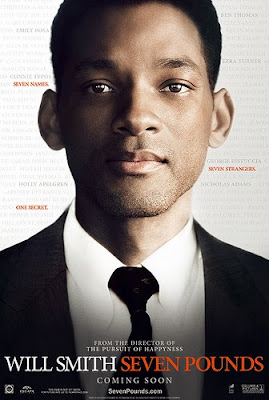
Seven Pounds


Will Smith can do almost anything, except make the ending of Seven Pounds easy to swallow. It is mawkish, emotionally manipulative and ridiculous.

Harsh? Yes, but how else would you react after sitting through two hours of a film that begins with the main character calling 911 to report his own suicide?

Smith plays Ben Thomas, an IRS agent down in the dumps over a tragic mistake he made. He has embarked on a plan to help seven strangers.

Smith, to his credit, masks all the qualities that he usually has at his disposal, mainly his considerable charm and sense of humor. We see only glimpses. The rest of the time, Smith is sullen, using bits of his charm to intrude into the lives of strangers to determine if they are in fact good people. It is an intense performance that keeps you engaged throughout much of the film.

You are pulled into the mystery of who Ben Thomas is and what he is doing. At times, he is rude; other times, kind. You, as the viewer, are continually thrown off.
But the director, Gabriele Muccino, shows his hands way too early, and by the first half, the audience has figured out Thomas' secret and what he plans to do. And so the film drags for another hour, as Thomas falls in love with Emily Posa, a vibrant woman with congenital heart failure. He wants to help her, but his plan hits a bump when he develops feelings for her.
Rosario Dawson plays Emily not as a victim but a woman who is trying to face her grim situation with a bit of hope. Her relationship with Thomas brings new life, however brief, to a man run down with grief.
Then the twist comes, not much of a shock, but one that is polarizing. Some in the audience will be touched. Others, like me, will just feel ripped off. The movie never earns the emotional payoff it is seeking. In many ways, the film is a cop out and you don't have once ounce of sympathy for the decision Thomas makes at the end, however altruistic it might seem.
What is this film trying to say? I don't know. The message of redemption is muddled by a main character who somehow sees himself as some flawed Christ-figure who can make amends through masochistic suffering.
I applaud Smith for taking chances with his acting and trying dark roles. But this just doesn't work.

Sunday, November 23, 2008

Twilight


Twilight, the first in a four-book series by Stephanie Meyer, is the Romeo and Juliet for the tween generation.

Except, Romeo hates sunlight and must tame his desire to suck the blood of his Juliet. Talk about a compelling reason to stay abstinent.

On the movie screen, the love affair of Bella and Edward plays out, much like it did in the book. But those who aren't fans of the series won't become fans because of this movie.


The film, as directed by Catherine Hardwicke, gets the angst of teenage life, especially in Bella (played brilliantly by Kristen Stewart). As the movie begins, Bella moves from Arizona to a small town called Forks to be with her father, who also happens to be the sheriff.


She has no friends, she is awkward and given to fits of clumsiness. And worst of all, she gets a beat-up red pick-up truck to ride around in.


On her first day of class, she meets Edward Cullen, a pale-faced heartthrob who almost becomes sick at the sight of her. Not a good impression, but Bella finds herself both disgusted and drawn to the mystery man.


It certainly doesn't hurt that Edward saves her life in a way that physics just can't explain. By the time she discovers Edward's secret -- he's a vampire who prefers animal blood -- she is "unconditionally and irrevocably" in love with him.


This is where things get tricky. Maybe in the 600-plus page book the movie is based on, we can believe that real love exists between Edward and Bella. But not in a two hour movie do you fully believe it.


The tension comes in the desires of both being unfulfilled because Edward cannot risk hurting his love by loving her. He cannot lose control even though every bit of his body wants to. Their love is unrequited.


But the "bite me so I can be with you forever" is a bit much to take, and guys dragged to this movie by their girlfriends will have to sit through an hour and a half of this overwrought dialogue to get to any action. And unfortunately, the action sucks. The special effects are awful and cheesy beyond belief. No teeth are bared, and all we get is a bunch of flying vampires. What is this? Super Vampire.


Nothing in this movie made me curious about the books or made me interested in seeing the

sequel. Maybe this is because I am not a teenage girl all in love with the whole idea of Edward Cullen. Oh well. Forgive me.


But I like vampire movies, and this wasn't one of the best. Sorry. I need something to sink my teeth in.

Saturday, November 15, 2008

Quantum of Solace


In Casino Royale, Daniel Craig gave James Bond something he had never had before -- edge, a smoldering rough, dare I say, thuggish quality missing in the more debonair, witty and smooth incarnations of Bonds past (i.e. Sean Connery).

And that edge is on full angry display in Quantum of Solace, an adrenaline-rush of a sequel that rarely stops for quiet introspection.

Not once does Bond say his signature line, "Bond, James Bond." He's way too busy going rogue, driving his boss, M (played by the always wonderful Judi Dench) crazy and killing people in awfully messy ways.

I was never much of a James Bond fan to begin with, but through Craig, we saw a James Bond that was more visceral and vulnerable, one who fell in love with a beautiful woman only to have her betray him and then die.

The new movie takes up where the last one left off, with Bond mourning the death of his lover, Vesper, and intently searching for her killer. What he discovers is a much greater conspiracy than he could have ever imagined, one that lurks in dark places.

At the center is Dominic Greene, a pseudo-environmentalist who is more interested in the kind of green that stacks. Joining Bond in his adventures is a different kind of Bond girl who, for a change, doesn't bed Bond because she's too focused on seeking revenge for the violent tragedies of her own life.

Marc Foster, the director of such moody pieces as Monster's Ball, gives us an action thriller with an actor's heart. He simply gives space for Craig to work.

Craig gives a muscular performance, both literally and figuratively, saying much in a simple look or gesture. And his scenes with M pop off the screen.

As a friend pointed out, this movie very much reminds one of the Bourne movies, very action packed with thrilling chases and bloody fist fights. I agree but I also think this movie continues an interesting reimagining of the Bond character.

Here, Bond has layers that we see peeled back. We see a heart beating behind the cold exterior. We discover glimpses of Bond's humanity that were hidden in other incarnations.

No, Quantum of Solace isn't nearly as good as Casino Royale, but it does very much leave you wanting to see what other secrets lie behind the seemingly inscrutable facade of 007.

Sunday, November 02, 2008

Zach & Miri Make a Porno


In the mind of Kevin Smith, crude and sweet occupy the same space. His films reflect that. Look past the profanity of Dogma, and you will find a semi-serious meditation on religion and spirituality.

Chasing Amy, a testosterone-drenched film about a man who falls in love with a lesbian, has one of the most heart-felt and eloquent declarations of love (from Ben Affleck, no less) from a man to a woman I have heard in quite some time.

And here we have Zach & Miri Make a Porno, which sums up the plot pretty well.

Zach (Seth Rogen of Knocked Up fame) and Miri (Elizabeth Banks who plays Laura Bush in Oliver Stone's W.) are best friends with dead-end jobs who struggle to pay the bills. When their lights go out and the rent is due, they decide they're going to make a porno featuring the two of them having sex.

Yes, there's nudity and yes, there are crude jokes galore. And there are actual porno stars like Traci Lords, who can blow bubbles, just not from her mouth.

The real center of the story is Zach and Miri and how the simple act of sex changes their relationship forever.

This is a syrupy sweet love story about two friends discovering that they might be more suited as lovers. But the trip from friends to lovers is littered with scatological humor that is not meant to be heard or seen by the innocent. Hey, this is about making a porno and it is rated R for a reason.

Banks is the perfect straight woman, and Rogen plays the same lovable slacker he always seems to play in every movie, but you have to admit he is good at it.

The jokes fall flat in the beginning but build up steam throughout. And Smith's usual cast of characters join in on the fun, including Jason Mewes, who usually plays the Jay of Jay and Silent Bob but here plays Lester who has a certain talent that only fans of pornos can appreciate.

We all know what's going to happen at the end, but the sweetness at the end of this crude machine feels worth it.

And after enduring all of that trashy talk, you somehow come out of the movie smelling good. That's a talent Kevin Smith can be proud of.

Saturday, October 25, 2008

The Secret Life of Bees


There is a quiet power to The Secret Life of Bees that sometimes threatens to spill over into over-the-top melodrama and pure sappiness.

It doesn't and that is a credit to the performances of the all-star cast anchored by rapper/actress Queen Latifah and Dakota Fanning, who is growing up to become a fine actress.

The movie, directed by Gina Prince Bythewood, is based on the novel by Sue Monk Kidd. The story is set in South Carolina in the 1960s when blacks were still fighting for their citizenship rights.

Fanning plays Lily Owens, a 14-year-old white girl carrying a dark secret who loves to write and is fascinated by the bees that swirl into her room one night.

Her father is abusive to her and crippled by the tragic loss of his wife years ago. Owens yearns to get away, and after Rosaleen, the black housekeeper played by Jennifer Hudson, is beaten and then arrested for trying to vote, Lily and Rosaleen run away to a small South Carolina town that is somehow connected to Lily's mother.

In that town, they find the Boatwright sisters, three black women who run a successful honey-making business. August Boatwright (Queen Latifah) is the oldest sister, followed by June (a feisty Alicia Keys), a civil-rights activist too serious for love, and May (Sophie Okonedo) who feels so deeply that she has built a wailing wall outside the house to cry her blues away.

The sisters offer a welcoming home in which Lily and Rosaleen can heal and find comfort. And August is the one who becomes a deep well of knowledge for Lily who must finally deal with the pain she has buried for so long.

Nothing really comes as a surprise in this movie. Even the death of a major character later in the movie isn't that much of a shock.

But in the end, it doesn't matter. Strong performances by all help keep the sappiness at bay, especially Queen Latifah, who could have easily allowed her character to fall into a stereotypical black mammy. She instead brings a complexity to her role. As does Alicia Keys, who gives June some layers as a woman too focused to focus on the fact that she needs love in her life.

Okonedo has the hardest job of all but finds the balance between being Sean Penn in I Am Sam and Dustin Hoffman in Rainman. She manages to maintain May's dignity and grace in a role that could have, in other hands, dispensed with both.

And the ending is just right, a wonderful high note in a movie that manages not to fall flat.

Monday, October 13, 2008

Miracle at St. Anna


Spike Lee is not subtle. His movies yell, pound you over the head to get your attention. If you wonder why, pick up Ralph Wiley's Why Black People Tend To Shout.

His intention is to provoke and he has done it in compelling ways, from Do The Right Thing to his most commercial outing, Inside Man. And Miracle at St. Anna is no different.

This story of an all-black Army unit fighting in Italy during World War II begins with an old man sitting in his apartment watching John Wayne in the movie, The Longest Day. Anger is sketched out in the wrinkles of his face as he quietly says, "We fought for this country too."

That sentiment is the theme that runs through this movie, an acknowledgement that black men sacrificed their lives for a country that refused to treat them as U.S. citizens.

A few minutes later, that old man, working in New York at a post office, inexplicably shoots another man. In his apartment is the head of a statute in Italy that's been missing since 1944.

And it is to this time that we are taken, where the old man is now a young Cpl. Hector Negron fighting as part of the all-black 92nd Infantry Division in Italy. The mystery of that statute head and why he shot that man will be solved by going back in time.

In 1944, alongside Negron is Sgt. Bishop Cummings (Michael Ealy), 2nd Staff Sgt. Aubrey Stamps (Derek Luke) and Private First Class Sam Train (Omar Benson Miller).

The four men soon find themselves trapped in an Italian village even as German forces plan a secret counterattack. Train forges a special relationship with a young boy he finds in a barn. And Cummings and Stamps boil over how to deal with an America that treats Germans better than black Americans as well as fight over the affections of an Italian woman.

Lee packs a lot into the film and sometimes the effort pays off. Especially poignant are the burgeoning relationship between the boy, Angelo, and Train.

And Lee gets at in powerful ways how ironic it is that black Americans feel freer in Italy than they do in their own country. No more is that hit home than in a scene in Louisian where the soldiers come to get something to eat and then are refused, even as German prisoners are given top-shelf service. The racism is of the in-your-face variety and it stings.

But this movie is not just about racism. It is about the tragedy of war and the humanity that sometimes rises out of that muck. We see evil in its worst form at the massacre at St. Anna where Nazi soldiers shot men, women and children begging for their lives.

Yet we also see compassion and the power of human kindness in a harsh world of betrayal and brutality.

There is a rough beauty in this film anchored by Lee's powerful direction, a more than appropriate score and wonderfully rendered cinematography.

Unfortunately, Lee may have been too ambitious, which is not a bad thing if you can hold your movie together. That doesn't happen. The film falls apart in the later half with an over-the-top ending, sentimental in ways Lee has never been and ripped from the much better The Shawshank Redemption. Even worse, having Stamps and Cummings fight over a woman doesn't reveal anything about their characters but only serves to distract from the seriousness of the movie.

Here, Lee forgets the simple power of a story beautifully told. He forgets to pull back.

But that's Lee, never suble, always yelling, resulting in a film that's sometimes too noisy for its own good.

Sunday, October 05, 2008

Nick and Norah's Infinite Playlist


Michael Cera may become the teenage romantic comedy hero of a new generation, possessing a sweet geeky charm no woman can apparently resist.

Or at least the women in the last few movies he's appeared in, including the wildly successful Juno, which also made Ellen Page a star.

In Nick and Norah's Infinite Playlist, he plays Nick, who plays in a band called The Jerkoffs. He makes mix CDs for his cheating girlfriend that he continues to pine after to the disgust of his fellow bandmates, who know he deserves someone better.

And someone better comes in the form of Norah, played by Kat Dennings, who scoops up Nick's mix CDs after his girlfriend throws them away.

As you can tell by the title, Nick and Norah are destined for each other. But their journey of love is filled with all kinds of wacky obstacles as they make their way to see fav band Where's Fluffy, which is playing somewhere that night.

First, though, Norah and Nick must find Norah's friend, Caroline (played by Ari Graynor), a perpetual drunk who has what we might tactfully call a special attachment to her gum. Her alcohol-fueled adventures are some of the most hilarious and outrageous and most enjoyable parts of this movie, and Graynor goes all out in her role, never pulling back regardless of how horrible she ends up looking. That is the essence of any comic actor.

Michael Cera and Kat Dennings display a cute chemistry toward each other, and when they finally do figure out how they feel about each other, it seems real, not forced, not fake.

This is a sweet movie without being an overly cheesy, puke-fest of romantic comedy cliche. And it doesn't hurt that the music rocks.

Monday, September 29, 2008

Eagle Eye


Eagle Eye, the new star vehicle for Shia Lebouf, tries very hard to not only be an action movie, but an action movie with a relevant message for our time about the loss of privacy and government overreaction.

And that would have been nice if the message wasn't beaten over a head near the end with characters giving nauseating didactic messages.

At least, the movie works well as pop entertainment, messy and forgettable the moment you walk out of the theater.

Shia Lebouf is Jerry Shaw, a charming slacker who wiles his days playing poker with his friends, working at a dead-end job at a Kinkos-like copy store and struggling to pay his rent. He also just buried his twin brother, who was in the military and much more ambitious. Then one day, Shaw goes to the ATM and finds $751,000 in his banking account. Soon, his apartment is crammed with boxes filled with weapons and he winds up in the custody of the FBI. And worse of all, a mysterious woman keeps calling and telling him to do various things like jump out of a building and slam his body to the floor before something crashes through the room he is in.

The same mysterious woman is calling Rachel, played by Michelle Monaghan, also telling her to do certain things or her son will die.

For awhile, the action is breathtaking as the two dodge bullets and end up in bruising car chases, with a cranky FBI agent played by Billy Bob Thorton hot on their tails.

Director DJ Caruso ratchets up the action here, obviously getting his tips from quick-cutting king Michael Bay. The result is shaky camera work, confusing audiences about what actually is happening on screen. Not a good thing. Felt like being on a bad roller coaster ride than watching a thrilling action movie.

Thank God Shia Lebouf has such a likable quality, a quick-wittedness and Joe Blow relatability that you find yourself rooting for the guy even in a movie as wacky as this one.

The plot meanders a bit before getting to its central thesis about the dangers of government having too much surveillance. Will Smith's Enemy of The State covered similar territory in a much better way.

And it's sad that the ultimate villain here takes its inspiration from 2001: A Space Odyssey. Oh, no, the computer is going to get me. Please, let's get a grip.

Here's how you enjoy Eagle Eye. Don't think too much either during the movie or immediately afterward. You'll only be disappointed.

Sunday, September 14, 2008

The Family That Preys


Tyler Perry is not known for being subtle. Far from in fact. His movies, many based on his popular gospel plays, are soap operas with plenty of broad over-the-top comedy, often featuring Perry as big-busted, pistol-carrying Madea, his most famous character.

Madea is nowhere to be found in Perry's latest creation, The Family That Preys (and if you didn't get that play on the word pray, well, you might need prayer).

The film centers on two families, one working class and the other wealthy. Charlotte, played by Kathy Bates, heads up the wealthy family, running a successful construction firm and butting heads with her spoiled son, William, played with snarling charm by Cole Hauser.

Alice (portrayed by the always wonderful Alfre Woodard) runs a diner and tries to instill old-fashioned values into her two daughters. Sanaa Lathan is Andrea, a financial accountant at the construction company who is carrying on an affair with William. She also chooses to run down her hardworking husband, Chris, who has dreams of starting a construction business of her own.

With all of this Dynasty-like drama going on, Charlotte decides this would be the perfect time for her and Alice to on a road-trip to see the country. So amid the seriousness, we see Charlotte trying to get Alice, the teetotaler, drunk, and then we see Alice drag Charlotte to get baptized.

There are no real surprises in Tyler Perry's movies. We know something is wrong with Charlotte. We know that all the secrets are going to come out. And we know someone is going to get slapped or punched or get hot grits thrown on them.

Perry isn't a sophisticated story-teller and doesn't deal well with complexities or nuances. He does, however, know what his audiences want and he delivers that with panache.

His movies are filled with messages of hope and faith and he has become better at delivering those messages without the heavy-handedness of his previous efforts.

And this time, he builds on the success he had with Why Did I Get Married instead of the clunker he had with Meet The Browns.

But he still has a way to go as a director. In this movie, we have long camera sweeps that seem to go nowhere but eventually find their way from one character to another, as music swells. He goes the other extreme of director Michael Bay, who is known for cutting his scenes so much that if you blinked you'd miss most of the movie.

Those technical flaws don't much matter to Perry's core audience. When my friend and I saw the movie, a woman talked throughout, like she was at home looking at one of her favorite afternoon soaps. She talked back at the screen, cheering on Charlotte and calling her Big Mama.

Good entertainment with a message. What else can you ask for?

Saturday, August 30, 2008

I'm Through with White Girls


One night, as I was browsing through Blockbuster, I had another reason why I don't do Netflix, much to the befuddlement of my friends who are well-aware of my movie-obsessed ways. It was all in the title, I'm Through with White Girls (The Inevitable Undoing of Jay Brooks).

Maybe I might have found this jewel through Netflix, but I highly doubt it. And like buying a CD off one hot single, I rented this movie based off just the title.

Sometimes you have to take a risk, which could end up in the catastrophe of a two-hour waste of time.
Or it could end up being the best time of your life, or close to it.
I'm Through with White Girls, the first feature by Jennifer Sharp, is surprisingly sweet romantic comedy about much more than the title might suggest.
Written by Courtney Lilly, the film centers on Jay Brooks, played to perfection by Anthony Montgomery, a black guy obsessed with graphic novels and indie rock and who dates too many white women to count. As one character suggests, the only black woman he may have kissed is his mother.
But what's nice here is that Jay Brooks isn't portrayed as some self-hating Clarence Thomas, which would have been the easy road to take here. As he says in the film, he dates white women because it seems as if black women don't dig him, and in the world in which he operates, he doesn't come across many black women at all.
That is until he starts Operation Brown Sugar. After his last break-up, in which he pens his Dear Jane letter on a yellow pad while his girlfriend is in the shower, he starts to rethink the way he runs his romantic life. He decides to go cold-turkey on white women, who he blames for his love woes.
He finally finds his match in author Catherine Williamson, a beautiful woman with blue-streaked dreadlocks who talks like a Valley girl. Jay Brooks falls hard and begs (literally) like Mars Blackmon in Spike Lee's She's Gotta Have It for a shot at love.
Lia Johnson, who plays Catherine, is a joy to behold on the screen. She exudes intelligence and vulnerability, and the chemistry between Catherine and Jay feels real.
Soon, Jay, not knowing a good thing when he has it, inadvertently starts sabotaging his chances with Catherine. And thus is revealed the real problem Jay has. It's not with white women; it's with commitment.
That journey to Jay Brooks undoing is a breezy one, full of insights about the silliness of stereotypes and the beauty of finding love and the freedom that comes with dance.


Sunday, August 17, 2008

Tropic Thunder


Tropic Thunder is satire overload, often funny but sometimes way over the head of the average viewer.

Perhaps that's the way Ben Stiller, the director, wanted, and he just about pulls it off.

His latest movie centers on the filming of a Vietnam War picture, replete with explosions, tough-guy talk, gore and drooling death scenes.

The movie goes haywire when half the set is blown up and the director decides to put his self-important actors in the middle of the jungle to shoot guerrilla style.

Those actors are a bunch of has-beens hoping for redemption. Stiller is muscle-bound Tugg Speedman, an action star on the rebound from a failed Oscar bid as a buck-toothed mentally-challenged guy named Simple Jack.

Jack Black plays Jeff Portnoy, a heroin-addicted comedian known for playing all the characters of a flatulent-happy family named The Fatties. And Robert Downey Jr. is a Method-acting Australian who is so convinced of his abilities that he decides to surgically darken his skin to play a black soldier.

Rounding out the cast is Jay Baruchel who plays Kevin Sandusky and Brandon T. Jackson who plays rapper Alpa Chino, who has his own energy drink, Booty Sweat.

There's really no plot other than the actors trying to find authenticity in their characters while being chased by real thugs with real guns shooting real bullets in a real jungle.

Eventually, Tugg Speedman ends up captured and the other actors have to save him.

And chaos ensues.

In the process, Stiller has a ball skewering the shallowness of Hollywood greed and the narcissism of some A-list actors. Tom Cruise even humiliates himself in an unrecognizable role as a bald-headed profanity-spewing studio head who loves to shake his butt to crass rap songs. (Just to see Tom Cruise dance is worth the ticket price alone).

Some of the jokes either fall flat or are just too insidery for most people to get. But more jokes work than not. And the energy of the cast is enough to pull the movie through its more dull moments.

Downey is clearly the star in one of the most controversial roles. Blackface isn't something you should mess with, given the history of blackface as a way to dehumanize African-Americans for centuries. But Downey doesn't go overboard and Alpa Chino is always there to challenge him.

About the funniest scene in the movie is when Lazarus explains to Speedman why he didn't win the Oscar.

Tropic Thunder should have been funnier, should have been grab your stomach as you roll on the floor funny, but it isn't. It is, however, eyes tear up every now and then funny, and sometimes, that's funny enough.

Saturday, July 26, 2008

The X-Files: I Want To Believe


There's something out there. That was the whole premise of The X-Files, the sci-fi series that ran for nine seasons.

FBI agents Fox Mulder and Dana Scully investigated mysteries that couldn't easily be explained by CSI-like forensics. The beauty of the show was in the tension between Scully and Mulder. Scully was the scientistwho constantly searched for the rational explanation.
And it was that rationalism that sometimes saved Mulder, the conspiracy-theorist haunted by his sister's kidnapping by aliens, from going over the edge.

Some shows were stand-alone exploration of things that go bump in the night. Others were about that large maze-like government cover-up involving shadowy figures such as The Smoking Man. In the midst of all that was the relationship between Mulder and Scully, at first platonic and then something more.
Ten years ago, Chis Carter, the creator, brought the series to the big screen in a plot tied to the show. It was a movie that pushed the series ahead, answering some questions and brining up new ones.
This time, The X-Files: I Want To Believe, junks all that conspiracy stuff. Instead, this is a standard episode stretched out to an hour and some change.
If only this movie was a better episode. But it isn't.
The movie picks up years after the series left off. Mulder and Scully are no longer with the FBI, the X-Files unit having been shut down. Mulder lives in isolation, throwing pencils to the ceiling, not shaving and clipping news articles. Scully is a surgeon trying to save the life of a sick boy.
Then a federal agent goes missing, and Scully is asked to find Mulder. And just like that, Mulder and Scully are back again, fulfilling their roles as believer and skeptic, respectively.
Added to that the fact that Scully and Mulder are a couple, their tension taking on a new dimension. In the center of the action is a defrocked pedophile priest played by Billy Connolly, who is given to visions he believes are sent by God.
Well, are they or is this priest a nut? That and Frankenstein-like human experimentation are essentially the plot here. No aliens to be found and certainly no conspiracy.
That's disappointing, putting it nicely. Even for what is a stretched-out episode, this movie doesn't hold much muster.
The script is weak, and Carter doesn't even try to engender much suspense. The series could be scary when it wanted, the bogeyman jumping out at you when you least expected. The twists were real twists, and when the credits ran, you felt a little unsettled, as if all the monsters hadn't been caught.
No monsters here, and the effort to bring some meaning to the relationship between Mulder and Scully ultimately fails. The climax is unsatisfying, and the ending doesn't haunt. The movie fades as soon as the end credits come on.
Some things should be left alone.

Saturday, July 19, 2008

The Dark Knight


Batman is a peculiar character in comic-book mythology. Unlike most superheroes, he is merely a very well-trained fighting machine with nifty gadgets, a sort of James Bond in a suit. He has no superpowers, just a tragic backstory about a boy who saw his parents slaughtered by punks and grew up to be a playboy billionaire who moonlights as a bat.

Tim Burton more than a decade ago gave us his vision of Bruce Wayne/Batman, full of Gothic stylings and over-the-top acting by Jack Nicholson as The Joker. The movie was light and heavy at the same time, the idea that Bruce Wayne might be off his rocker lurking beneath.

But when Christopher Nolan got a hold of the Batman franchise (after director Joel Schumacher ruined it), he gave us less of the Batman and more of Bruce Wayne in Batman Begins. Wayne became flesh, flawed yet noble as protagonists tend to be in tragedies.

Nolan gave us an imaginative reinvention of a beloved superhero. In The Dark Knight, he gives us so much more.

Much has been made about the performance of the late Heath Ledger as The Joker in this film. Some say it's Oscar-worthy. Others wonder if the praise is coming simply because Ledger died a young age.

Well, the performance is all that. Ledger's Joker is much scarier, more twisted and just plain creepier than Nicholson's 1989 version. The make-up is smeared, and The Joker licks his lips and talks in the skin-crawling voice of a man rotting from the inside out.

He is the perfect villain for the Batman. The Joker is an agent of chaos, a madman whose only purpose in life is to watch the world burn. In Burton's Batman, we know how The Joker got that smile. In Nolan's version, we're not quite sure. The Joker tells two different stories, both equally creepy. He is a villain allergic to rationality. He lives by his own twisted logic.

Batman is Gotham City's guardian. He wants to restore order. The Joker wants to blow it up. How does the good guy catch a criminal who revels in anarchy, who ups the ante at every chance?

What makes Nolan's recent venture into the Batman franchise is that this doesn't feel like a summer blockbuster. Yes, we have the elaborate action sequences that look authentic and not CGI'ed to death. We have kung-fu fighting (or whatever martial arts Batman uses in this film). We have romance. We have all the elements you want in a superhero movie.

But we have something more. We have a director interested in the spaces between black and white.

There are no easy answers in The Dark Knight. Bruce Wayne wants to give up being Batman, let hard-charging DA Harvey Dent be the white knight, and maybe he can get his girl, Rachel Dawes back.

Life is never that easy, doesn't operate that way, and even though this is comic-book fantasy, it feels more than any recent super-hero movie like the real world.

Dent says this in the middle of the movie: "Either you die the hero or you live just long enough to become the villain."

That applies not only to Dent, who eventually becomes the scarred villain Two-Face, but to Batman himself. The idea of doing the greatest good for the greatest number is fully explored in this film. Batman is not Superman saving some damsel in distress, and The Joker isn't some villain with plans for world domination. As Alfred says, some men just want to see the world burn.

The Dark Knight lives up to 1/3rd of its title. This is one dark, near-depression levels super-hero movie. Not that there isn't fun. The Joker is a lot of fun. He's just not fun to be around. Neither is the Batman.

We have here a movie with layers, pulp with Shakespearean aspirations, a superhero who has both physical and psychic wounds that are not easily healed. And we have evil that is hard to defeat because it becomes bolder the more Batman fights it.

Heavy stuff for a summer blockbuster, indeed. Oh well, why so serious?

Saturday, July 12, 2008

Hancock/Hellboy


So far this has been a great summer for superheroes. Iron Man, with Robert Downey Jr. in the title role was fun with an edge. The Incredible Hulk delivered the smashing good time we had wanted in Ang Lee's much maligned attempt five years ago.


And now we have Hancock and Hellboy II: The Golden Army, a way to whet our appetites before the main feast that opens later this month, The Dark Knight.


First up is Hancock, where Will Smith plays a different kind of superhero, the mean kind that is. Smith has always gotten by on his considerable charm and charisma, which have helped him maintain his status as summer box-office king for years.


Here he plays John Hancock, a drunk whose uniform is apparently the latest in bum fashion. He saves lives as any superhero does, but he also has a filthy mouth and causes destruction while he saves lives. And as a result, people in Los Angeles hate him.


All except Ray Embrey, the do-gooder PR guy. Hancock saves Embrey's life and Embrey decides that he'll pay Hancock back by doing some image makeover.


It's pretty much impossible to hate Will Smith, even when he's playing a jerk like Hancock. And the first part of the movie is full of hilarious bits where Hancock tries his darndest to be nice and polite and not use the "F" word too much, all while doing his Superman thing.


Then a twist (why must there always be a twist) comes in the second half that's halfway cool if it had been executed with a little more panache.


And there's a rather vague origin story that doesn't make much sense the more you think about it. The movie with the intriguing premise turns into just another conventional superhero movie with a disappointing villain and lots of mushy talk about responsibility and the consequences of your actions.


It seems as if Peter Berg, the director, got confused about what kind of movie he wanted to make, a comedy or drama or some combination of both. Who knows?


Will Smith does deliver but you wish he could have delivered in a much better movie.


Hellboy II: The Golden Army, on the other hand, is a visual delight. Director Guillermo Del Toro has a gift for creating a magical world in which weirdness is normal.


Ron Perlman plays the red guy with horns, a supposed spawn of Satan who manages to do good with a wiseacre, kick-butt attitude.


The mythology is dense. Long long time ago, man made a peace treaty with the freaks. Man can have the cities and the monsters that go bump in the night can have the forests. Everyone agreed except this pale-faced dude named Prince Nuada, a real party-ruiner who moves like Bruce Lee. Centuries ago, he went into exile.


Now he's returned, looking for the pieces of a crown that put together has the power to awaken the dreaded, indestructible Golden Army.


Back for action, besides Hellboy, is his fiery (literally) girlfriend Liz, the gill-faced bookworm Abe, and Johann Kraus, who is all fog and no substance (again literally).


In short, Nuada hates humans and wants to destroy the world (as most villains want to do). And Hellboy and his gang have to stop him.


So the plot isn't that original, but Del Toro's vision is, full of fantastical creatures in weird shapes. One creature's face looks like half of a moon crater. Another appears to carry London on his head.


And there's this wondrous creature who torments the city and has this incredible transformation that I won't spoil for you.


Perlman gives the horn-headed Hellboy a lovable sourness and boyish charm. Plus, he and Selma Blair, who plays Liz, have good chemistry. Their arguments are a lot of fun and a little dangerous.


This is a wild, gorgeously shot ride, an art film masquerading as a summer blockbuster.